
Salins French Faience Deep Plate with Blue Botanical Transfer Print
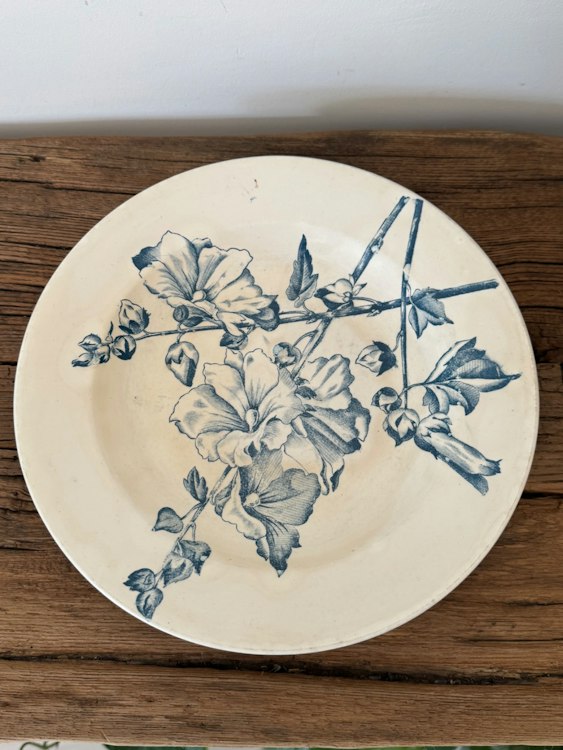
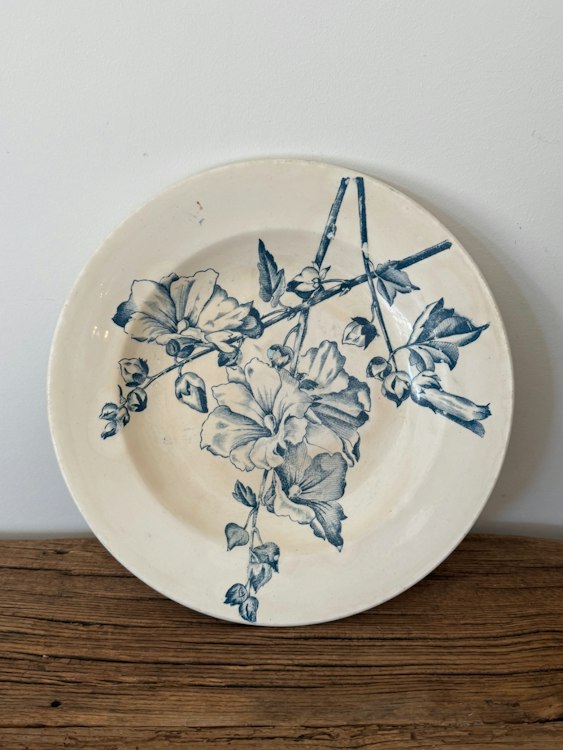
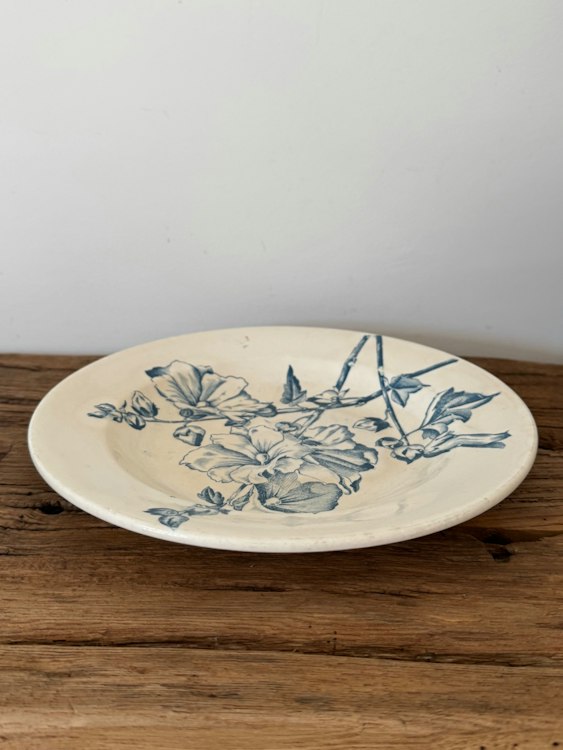
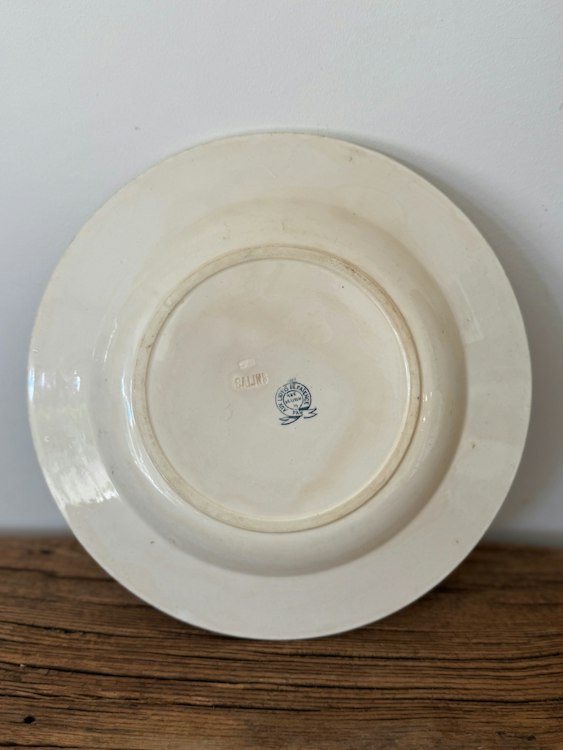
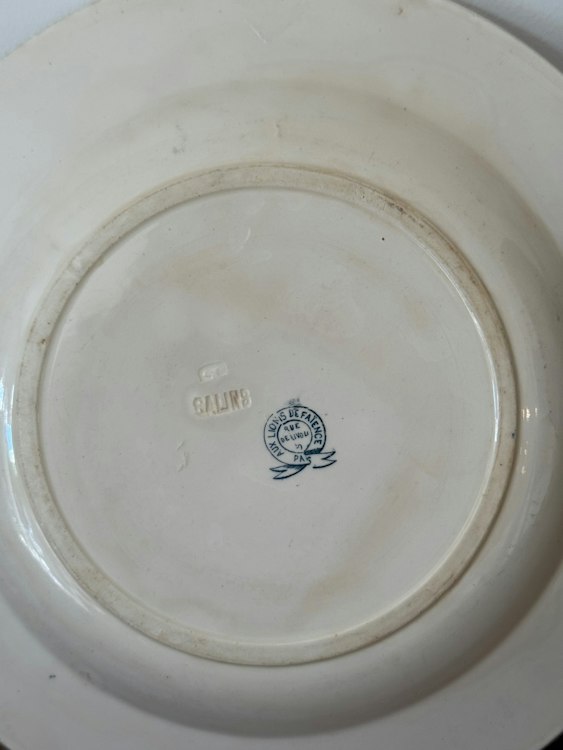
About product: A French late 19th-century fine earthenware deep plate (assiette creuse) produced by the Faïencerie de Salins (Salins-les-Bains, Jura, France). The basin and rim feature an asymmetric, monochrome cobalt-blue transfer-printed botanical study depicting blooming hollyhocks (rose trémière) with detailed petals, buds, and foliage in the Art Nouveau manner. The reverse bears the impressed maker's mark "SALINS" alongside an underglaze blue printed retailer's mark reading "AUX LYS DE FAIENCE / 185 RUE ST DENIS / PARIS". Product Specifications - Subject / Source: Botanical study of flowering hollyhocks (Alcea rosea / rose trémière) - Artist / Maker: Faïencerie de Salins (Salins-les-Bains, France) - Period: Art Nouveau (c. 1890–1910) - Origin: France - Material / Technique: Underglaze transfer-printed earthenware (faïence fine) - Markings: Impressed "SALINS" to underside; blue transfer mark "AUX LYS DE FAIENCE / 185 RUE ST DENIS / PARIS" - Retailer / Dealer label: Aux Lys de Faïence, 185 Rue Saint-Denis, Paris — a late 19th-century Parisian tableware emporium - Colour & Surface: Cream ground with cobalt-blue monochrome transfer print - Condition: Minor surface wear and faint glaze crazing consistent with age; light rim rubs, otherwise free of chips or cracks History: Founded in 1857 in the Jura region of eastern France, the Faïencerie de Salins-les-Bains became celebrated for its fine earthenware tableware during the late 19th and early 20th centuries. Specialized Parisian retailers such as Aux Lys de Faïence on Rue Saint-Denis distributed these elegant floral services to refined urban households, reflecting the Belle Époque fascination with naturalistic flora and Japanese-influenced botanical compositions.
$78.00+ shipping
A French late 19th-century fine earthenware deep plate (assiette creuse) produced by the Faïencerie de Salins (Salins-les-Bains, Jura, France). The basin and rim feature an asymmetric, monochrome cobalt-blue transfer-printed botanical study depicting blooming hollyhocks (rose trémière) with detailed petals, buds, and foliage in the Art Nouveau manner. The reverse bears the impressed maker's mark "SALINS" alongside an underglaze blue printed retailer's mark reading "AUX LYS DE FAIENCE / 185 RUE ST DENIS / PARIS".
Product Specifications
- Subject / Source: Botanical study of flowering hollyhocks (Alcea rosea / rose trémière)
- Artist / Maker: Faïencerie de Salins (Salins-les-Bains, France)
- Period: Art Nouveau (c. 1890–1910)
- Origin: France
- Material / Technique: Underglaze transfer-printed earthenware (faïence fine)
- Markings: Impressed "SALINS" to underside; blue transfer mark "AUX LYS DE FAIENCE / 185 RUE ST DENIS / PARIS"
- Retailer / Dealer label: Aux Lys de Faïence, 185 Rue Saint-Denis, Paris — a late 19th-century Parisian tableware emporium
- Colour & Surface: Cream ground with cobalt-blue monochrome transfer print
- Condition: Minor surface wear and faint glaze crazing consistent with age; light rim rubs, otherwise free of chips or cracks
History
Founded in 1857 in the Jura region of eastern France, the Faïencerie de Salins-les-Bains became celebrated for its fine earthenware tableware during the late 19th and early 20th centuries. Specialized Parisian retailers such as Aux Lys de Faïence on Rue Saint-Denis distributed these elegant floral services to refined urban households, reflecting the Belle Époque fascination with naturalistic flora and Japanese-influenced botanical compositions.