
Hand Painted Porcelain Open Salt Cellars
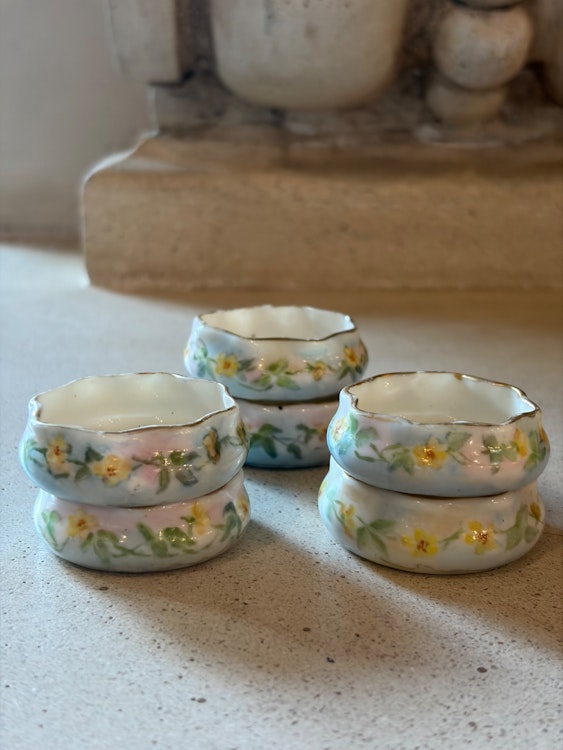
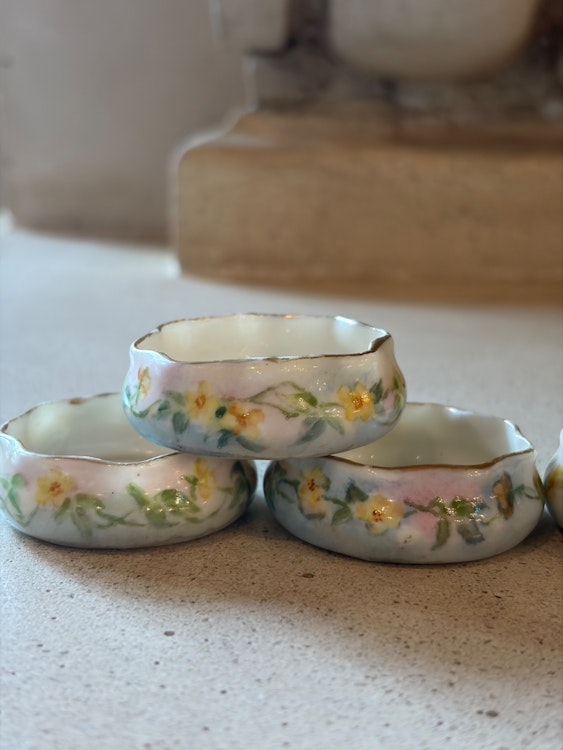
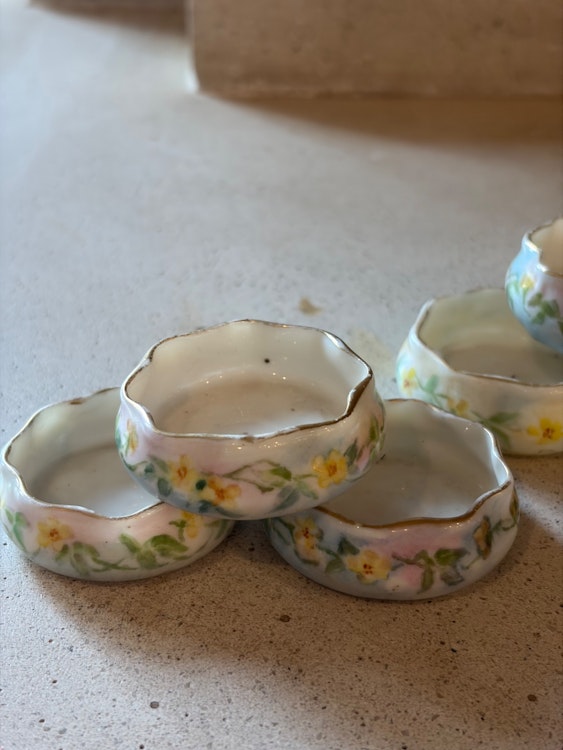
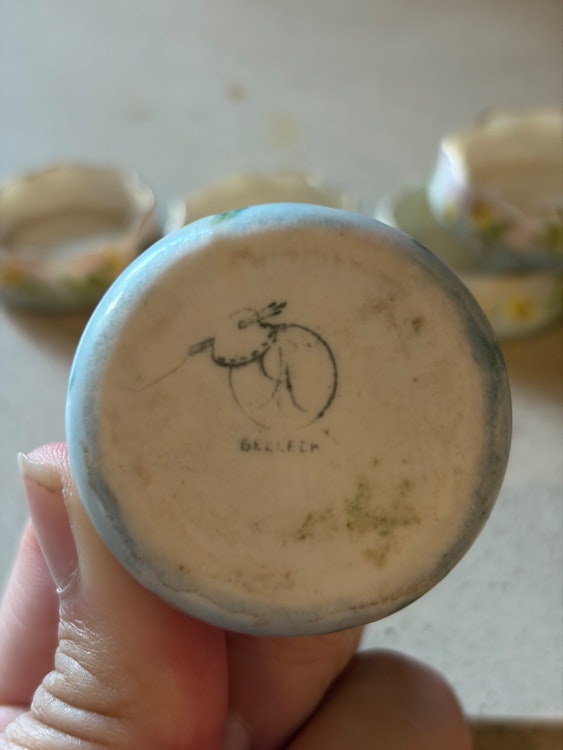
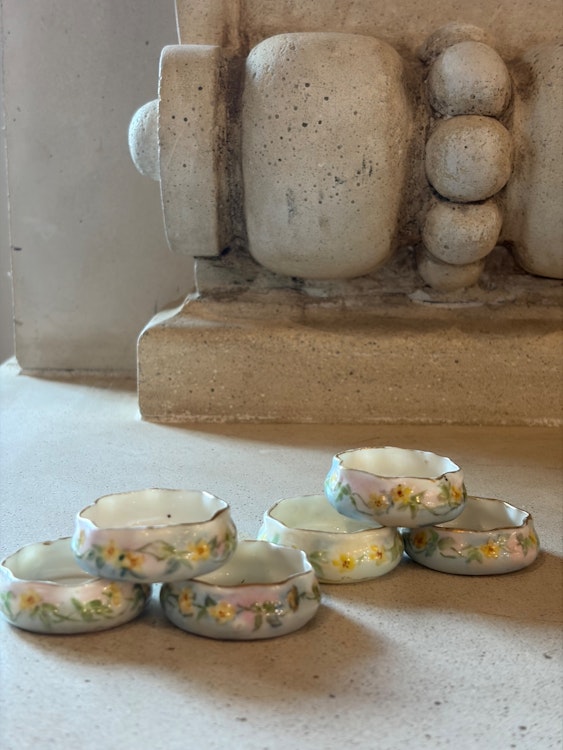
About product: A set of 6 delicate, thin-walled porcelain open salt cellars, each featuring a gently scalloped gilt rim and a compressed bulbous form. The exteriors are hand-painted with a continuous band of yellow buttercups or wild roses amidst green foliage, set against a soft, pearlescent lustre glaze of blended pale blue, pink, and white tones. The undersides bear a distinctive mark consisting of a circle topped with a ribbon bow, enclosing a stylized monogram, with the word "BELLEEK" stamped or hand-painted below. This mark is characteristic of early 20th-century porcelain produced either as American Belleek blanks decorated by studio artists, or as Japanese 'Nippon' porcelain wares created in imitation of Irish Belleek. Historical & Style Details - Subject / Style: Belleek style - Quantity: Set of six (6) - Medium / Technique: Hand-painted porcelain with lustre glaze and gilding - Materials: Porcelain, gold gilt - Markings: Stamped/painted mark on underside of a circle with a bow on top and "BELLEEK" below - Decorative Details: Scalloped rims, yellow floral sprigs, iridescent blue and pink ground - Condition: Very good vintage condition; minor wear to the gilt rims and light shelf wear to the bases History: During the late 19th and early 20th centuries, the exquisite, translucent parian porcelain produced by the Belleek Pottery in Ireland inspired numerous imitators and competitors. In the United States, manufacturers like Willets and Lenox produced high-quality 'American Belleek' blanks for amateur and professional china painters, while Japanese manufacturers exported similar lustre-glazed wares to the Western market. These delicate salt cellars represent the height of the early 20th-century fashion for hand-painted, iridescent tableware.
$45.00+ shipping
A set of 6 delicate, thin-walled porcelain open salt cellars, each featuring a gently scalloped gilt rim and a compressed bulbous form. The exteriors are hand-painted with a continuous band of yellow buttercups or wild roses amidst green foliage, set against a soft, pearlescent lustre glaze of blended pale blue, pink, and white tones.
The undersides bear a distinctive mark consisting of a circle topped with a ribbon bow, enclosing a stylized monogram, with the word "BELLEEK" stamped or hand-painted below. This mark is characteristic of early 20th-century porcelain produced either as American Belleek blanks decorated by studio artists, or as Japanese 'Nippon' porcelain wares created in imitation of Irish Belleek.
Historical & Style Details
- Subject / Style: Belleek style
- Quantity: Set of six (6)
- Medium / Technique: Hand-painted porcelain with lustre glaze and gilding
- Materials: Porcelain, gold gilt
- Markings: Stamped/painted mark on underside of a circle with a bow on top and "BELLEEK" below
- Decorative Details: Scalloped rims, yellow floral sprigs, iridescent blue and pink ground
- Condition: Very good vintage condition; minor wear to the gilt rims and light shelf wear to the bases
History
During the late 19th and early 20th centuries, the exquisite, translucent parian porcelain produced by the Belleek Pottery in Ireland inspired numerous imitators and competitors. In the United States, manufacturers like Willets and Lenox produced high-quality 'American Belleek' blanks for amateur and professional china painters, while Japanese manufacturers exported similar lustre-glazed wares to the Western market. These delicate salt cellars represent the height of the early 20th-century fashion for hand-painted, iridescent tableware.