
French Terre de Fer Transferware Plate, 'Service Champêtre' Pattern, La Samaritaine
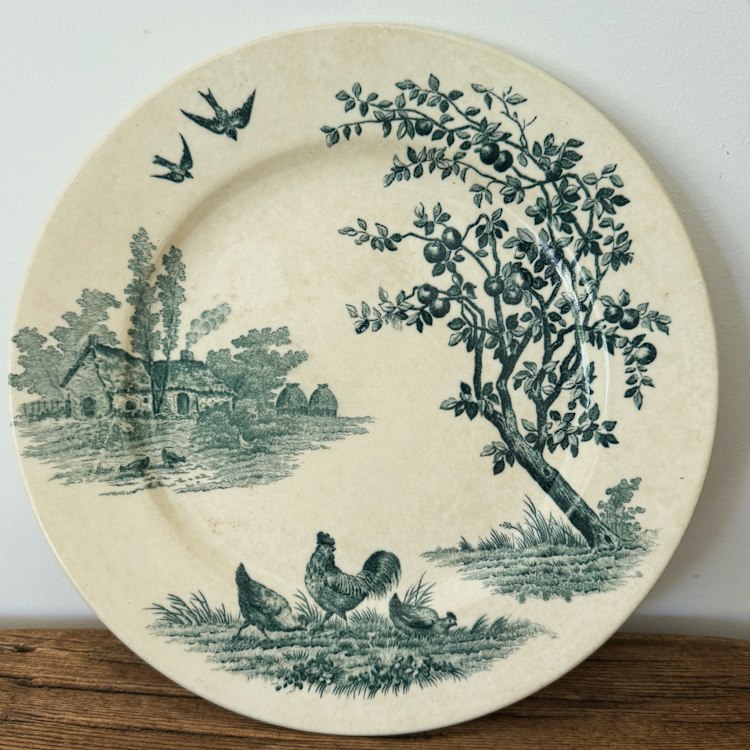
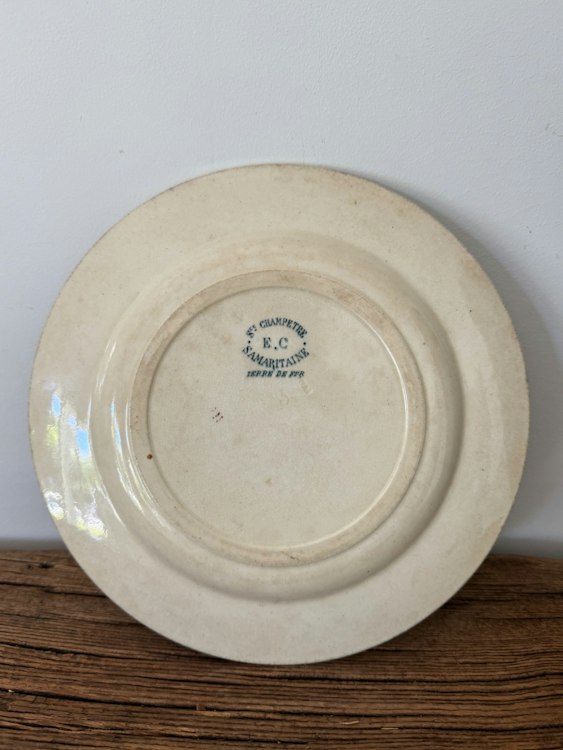
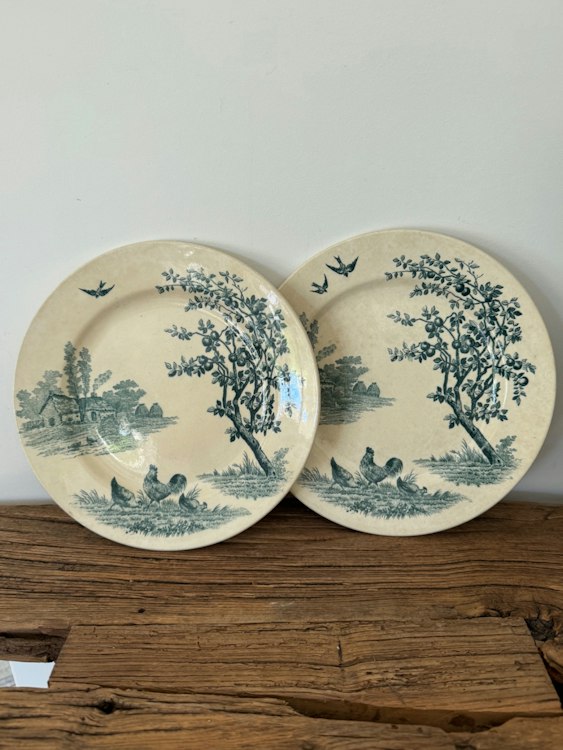
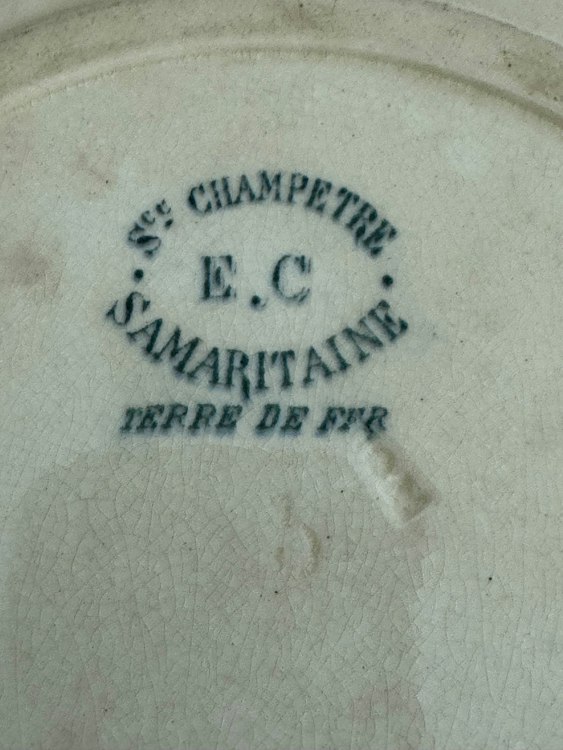
About product: A late 19th- to early 20th-century French *terre de fer* earthenware plate decorated in a rich teal-green underglaze transfer print. The pattern, titled 'Service Champêtre', presents an asymmetrical rural vignette featuring a heavily laden apple tree to the right, chickens and a rooster foraging in the foreground, swallows swooping overhead, and a thatched farm cottage surrounded by trees in the middle distance. Historical & Style Details - Subject / Sitter: Pastoral farmyard landscape with apple tree, poultry, swallows, and cottage - Artist / Maker: Initialed "E.C", produced for La Samaritaine - Period: Late 19th to early 20th century (circa 1890–1910) - Origin: France - Material / Technique: Transfer-printed glazed earthenware (*terre de fer*) - Markings: Underglaze teal printed backstamp reading "Sce CHAMPETRE / E.C / SAMARITAINE / TERRE DE FER" with an impressed numeral mark - Retailer / Dealer label: Commissioned or sold by Grands Magasins de La Samaritaine, Paris - Colour & Surface: Cream earthenware glaze with dark teal/blue-green transfer decoration and fine age-crazing - Condition: Overall fine antique condition; uniform glaze crazing consistent with age, no chips, cracks, or restoration visible History: *Terre de fer* (iron earth) is a hard, dense French earthenware reinforced with feldspar and kaolin, popularised from the 1870s through the early 20th century by major potteries such as Choisy-le-Roi, Moulin des Loups, and Saint-Amand. Bucolic country themes ('Service Champêtre') were widely sought after during the Belle Époque era, often retailed through major Parisian department stores like La Samaritaine to meet the growing domestic demand for decorative tableware.
$74.00+ shipping
A late 19th- to early 20th-century French *terre de fer* earthenware plate decorated in a rich teal-green underglaze transfer print. The pattern, titled 'Service Champêtre', presents an asymmetrical rural vignette featuring a heavily laden apple tree to the right, chickens and a rooster foraging in the foreground, swallows swooping overhead, and a thatched farm cottage surrounded by trees in the middle distance.
Historical & Style Details
- Subject / Sitter: Pastoral farmyard landscape with apple tree, poultry, swallows, and cottage
- Artist / Maker: Initialed "E.C", produced for La Samaritaine
- Period: Late 19th to early 20th century (circa 1890–1910)
- Origin: France
- Material / Technique: Transfer-printed glazed earthenware (*terre de fer*)
- Markings: Underglaze teal printed backstamp reading "Sce CHAMPETRE / E.C / SAMARITAINE / TERRE DE FER" with an impressed numeral mark
- Retailer / Dealer label: Commissioned or sold by Grands Magasins de La Samaritaine, Paris
- Colour & Surface: Cream earthenware glaze with dark teal/blue-green transfer decoration and fine age-crazing
- Condition: Overall fine antique condition; uniform glaze crazing consistent with age, no chips, cracks, or restoration visible
History
*Terre de fer* (iron earth) is a hard, dense French earthenware reinforced with feldspar and kaolin, popularised from the 1870s through the early 20th century by major potteries such as Choisy-le-Roi, Moulin des Loups, and Saint-Amand. Bucolic country themes ('Service Champêtre') were widely sought after during the Belle Époque era, often retailed through major Parisian department stores like La Samaritaine to meet the growing domestic demand for decorative tableware.