
Framed French educational needlework stitch chart 'Points de Couture' in giltwood frame
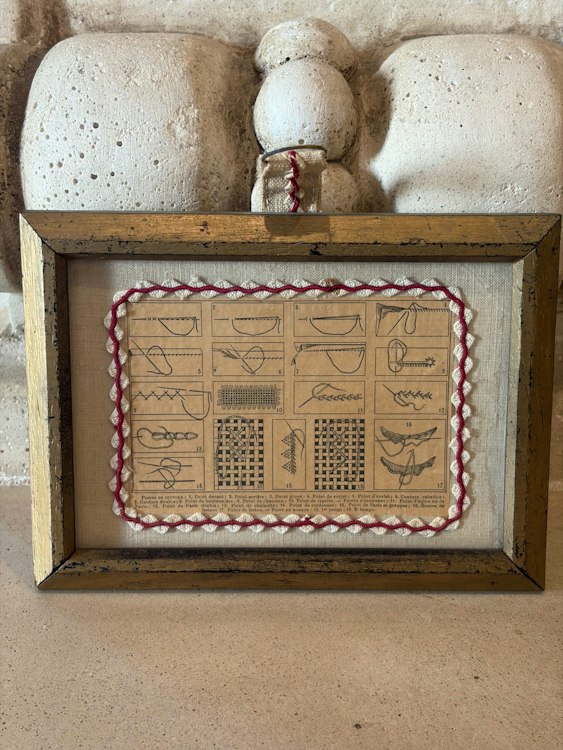
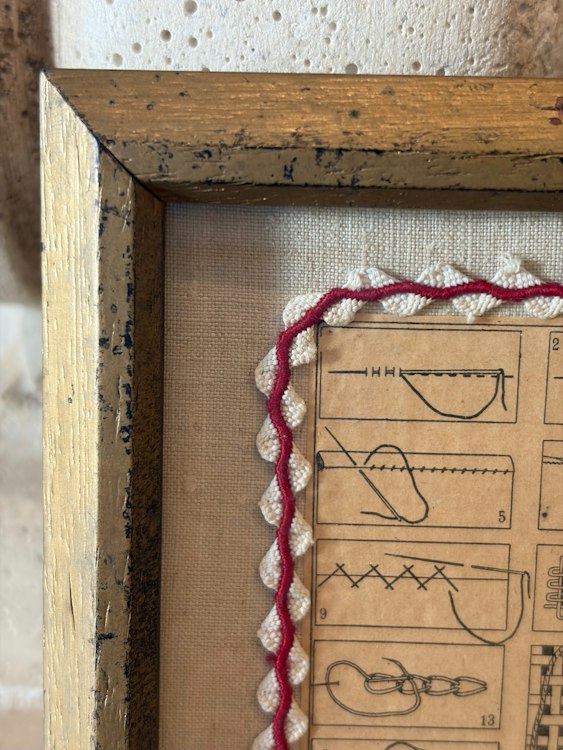
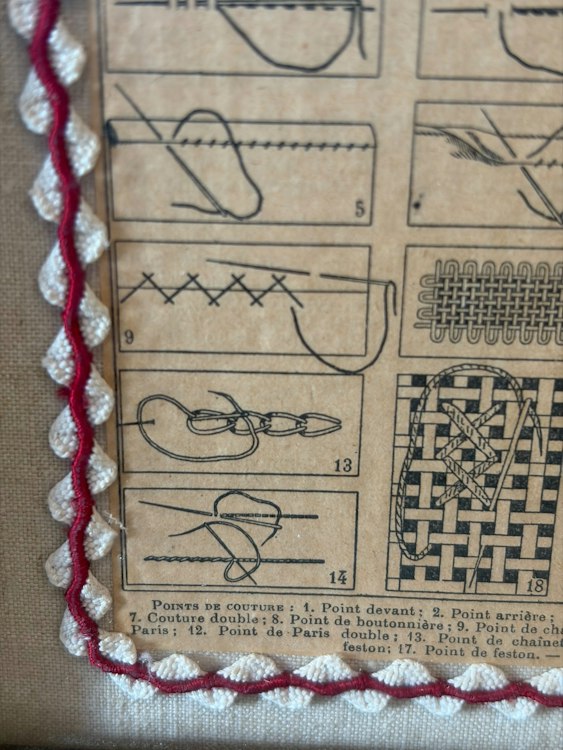
About product: A decorative framed presentation featuring an authentic French educational needlework stitch reference chart, titled "POINTS DE COUTURE". The printed diagram illustrates nineteen fundamental sewing, ornamental, and marking stitches, mounted upon a coarse woven linen backing board and framed with a red and white wave ric-rac trim within a giltwood frame with an antiqued finish. Framing & Provenance - Subject / Source: French hand-sewing and embroidery stitch reference chart ("Points de couture", "Points d'ornement", "Point de marque") - Material / Technique: Printed paper diagram mounted on woven linen fabric, cotton ric-rac braid trim, giltwood frame - Markings: Printed caption reading "POINTS DE COUTURE : 1. Point devant ; 2. Point arrière ; 3. Point piqué ; 4. Point de surjet ; 5. Point d'ourlet ; 6. Couture rabattue ; 7. Couture double ; 8. Point de boutonnière ; 9. Point de chausson ; 10. Point de reprise. - POINTS D'ORNEMENT : 11. Point d'épine ou de Paris ; 12. Point de Paris double ; 13. Point de chaînette ; 14. Point de cordonnet ; 15. Point de Paris et grappes ; 16. Bourre de feston ; 17. Point de feston. - POINT DE MARQUE : 18. 1er temps ; 19. 2e temps." - Retailer / Dealer label: Reverse bears yellow paper shop label reading "Un Air de Campagne / Brocante - Décoration - Cadeaux / Modèle unique / Ouvrages personnalisés / (Coussins - Petits Rideaux - etc...) / Olargues / 04 67 37 92 82 (répondeur)" - Frame: Molded wooden frame with distressed gilding, hardboard backboard secured with brass nails, stitched fabric hanging ribbon at top - Condition: Minor age-toning and faint foxing spots to paper chart; deliberate light distressing to frame finish History: Printed needlework stitch plates and sewing reference sheets were widespread in French primary education and domestic manuals throughout the early to mid-20th century. Custom assemblages recontextualizing historical haberdashery prints on vintage homespun linen are characteristic of late 20th-century French provincial brocante ateliers, such as those in Olargues in the Hérault region of southern France.
$50.00+ shipping
A decorative framed presentation featuring an authentic French educational needlework stitch reference chart, titled "POINTS DE COUTURE". The printed diagram illustrates nineteen fundamental sewing, ornamental, and marking stitches, mounted upon a coarse woven linen backing board and framed with a red and white wave ric-rac trim within a giltwood frame with an antiqued finish.
Framing & Provenance
- Subject / Source: French hand-sewing and embroidery stitch reference chart ("Points de couture", "Points d'ornement", "Point de marque")
- Material / Technique: Printed paper diagram mounted on woven linen fabric, cotton ric-rac braid trim, giltwood frame
- Markings: Printed caption reading "POINTS DE COUTURE : 1. Point devant ; 2. Point arrière ; 3. Point piqué ; 4. Point de surjet ; 5. Point d'ourlet ; 6. Couture rabattue ; 7. Couture double ; 8. Point de boutonnière ; 9. Point de chausson ; 10. Point de reprise. - POINTS D'ORNEMENT : 11. Point d'épine ou de Paris ; 12. Point de Paris double ; 13. Point de chaînette ; 14. Point de cordonnet ; 15. Point de Paris et grappes ; 16. Bourre de feston ; 17. Point de feston. - POINT DE MARQUE : 18. 1er temps ; 19. 2e temps."
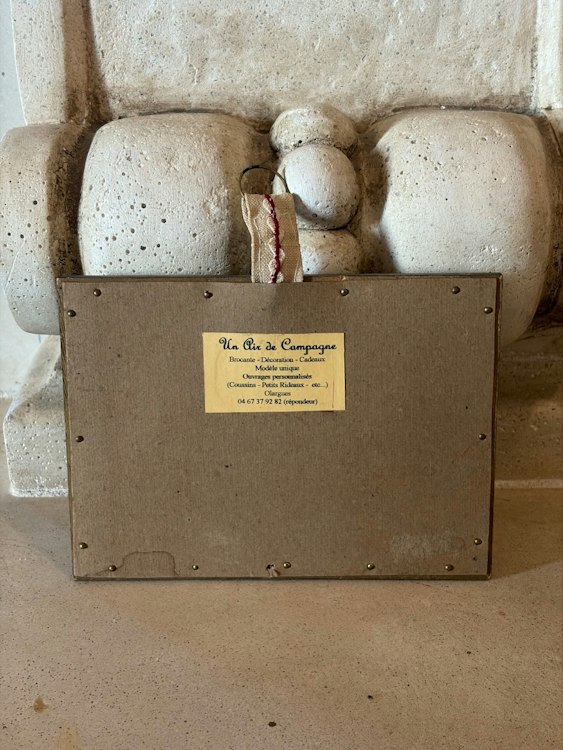
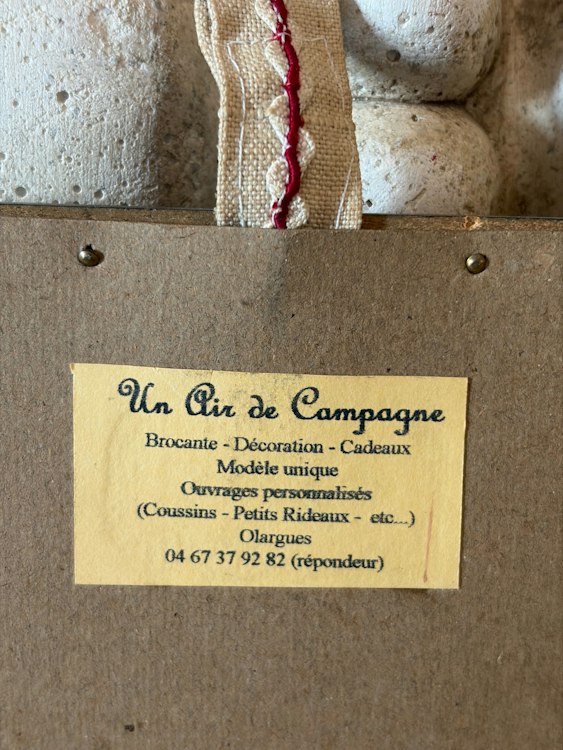
- Retailer / Dealer label: Reverse bears yellow paper shop label reading "Un Air de Campagne / Brocante - Décoration - Cadeaux / Modèle unique / Ouvrages personnalisés / (Coussins - Petits Rideaux - etc...) / Olargues / 04 67 37 92 82 (répondeur)"
- Frame: Molded wooden frame with distressed gilding, hardboard backboard secured with brass nails, stitched fabric hanging ribbon at top
- Condition: Minor age-toning and faint foxing spots to paper chart; deliberate light distressing to frame finish
History
Printed needlework stitch plates and sewing reference sheets were widespread in French primary education and domestic manuals throughout the early to mid-20th century. Custom assemblages recontextualizing historical haberdashery prints on vintage homespun linen are characteristic of late 20th-century French provincial brocante ateliers, such as those in Olargues in the Hérault region of southern France.