
Creil et Montereau faience fine Nouveau Testament plates, pair, c. 1855
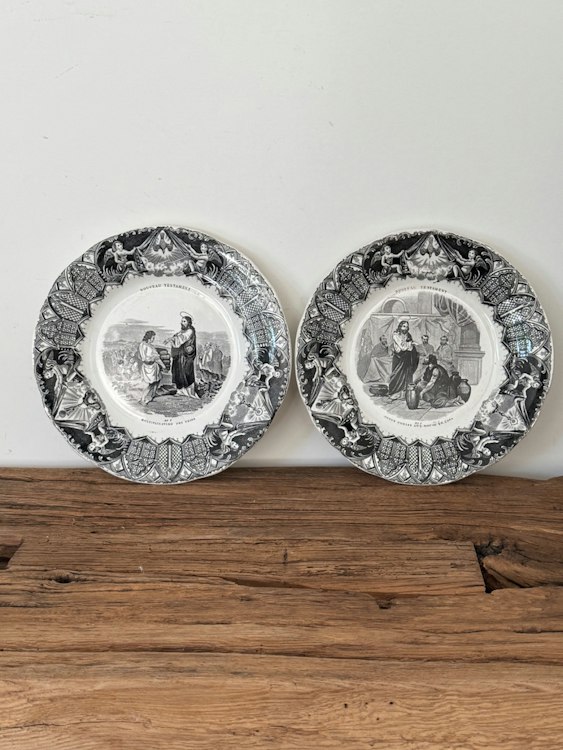
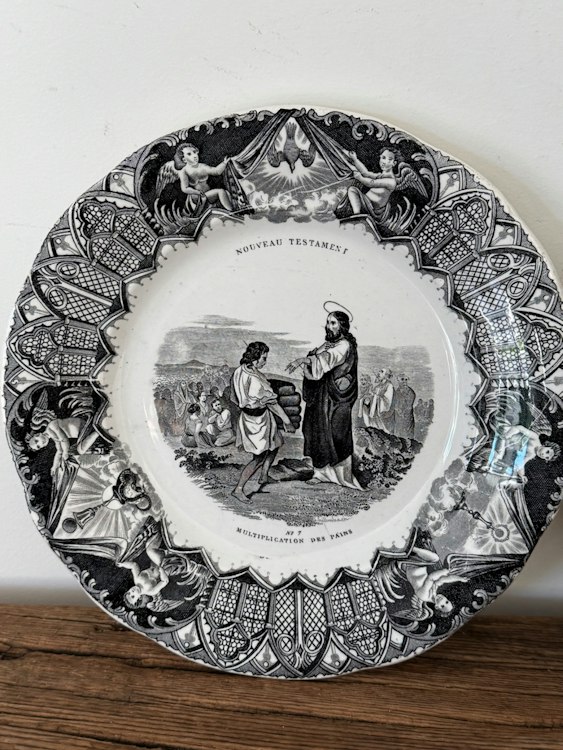
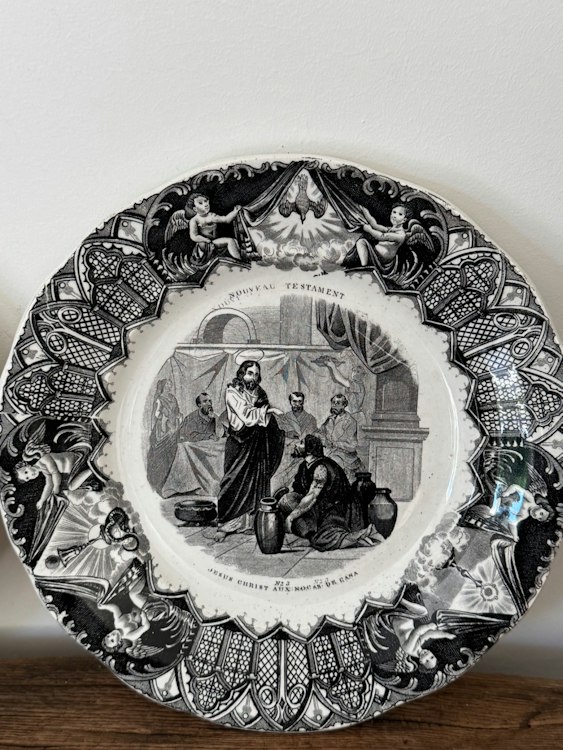
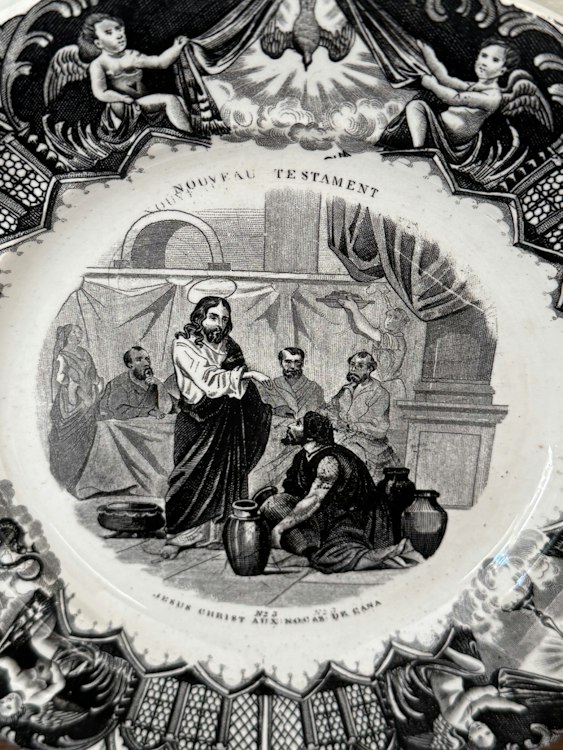
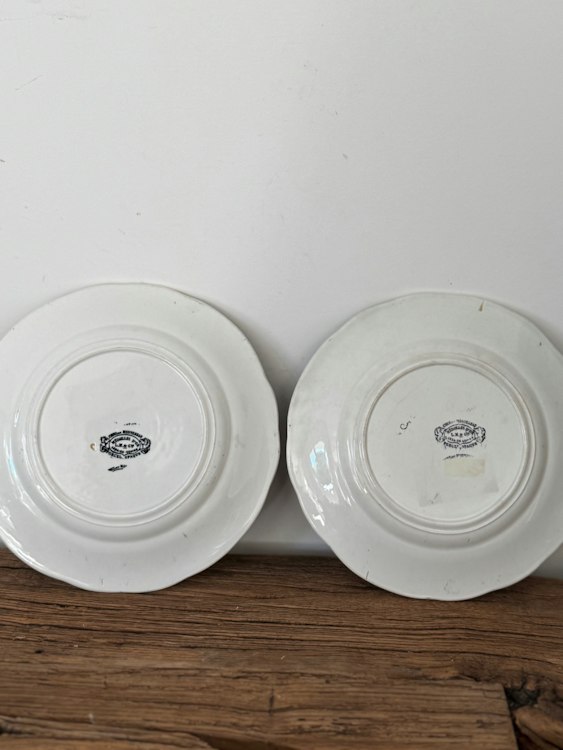
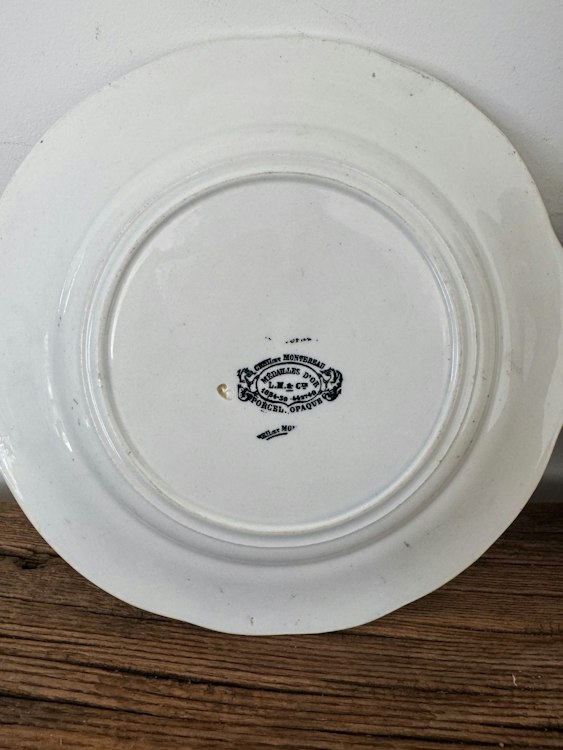
About product: A pair of French mid-19th-century black transfer-printed creamware (*faïence fine*) decorative plates by the renowned manufacture Creil et Montereau, produced under the direction of Leboeuf, Milliet & Cie. The central medallions illustrate key narrative episodes from the New Testament: Plate N° 2 depicts *JESUS CHRIST AUX NOCES DE CANA* (The Wedding at Cana), showing Christ blessing the water jars amidst banquet guests, while Plate N° 7 depicts *MULTIPLICATION DES PAINS* (Feeding of the Multitude), showing Christ accepting loaves from a youth before a crowd. Each central scene is framed by an elaborate Neo-Gothic revival border featuring cathedral window tracery pattern work, flanked by putti and surmounted by a central cartouche of two angels pulling back drapery to reveal the Holy Spirit in the form of a dove radiating heavenly light. Condition Report & Provenance - Subject / Source: New Testament scenes (N° 2 "JESUS CHRIST AUX NOCES DE CANA" and N° 7 "MULTIPLICATION DES PAINS") - Artist / Maker: Creil et Montereau (Leboeuf, Milliet & Cie) - Period: Mid-19th Century (c. 1855–1870) - Origin: France - Material / Technique: Black transfer print (*grisaille*) on cream earthenware (*faïence fine* / *porcelaine opaque*) - Markings: Backstamped on reverse with oval mark inscribed "CREIL ET MONTEREAU / MÉDAILLES D'OR / L.M & C° / 1834. 39. 44. 49 & 55 / PORCEL. OPAQUE" - Decorative Details: Neo-Gothic architectural tracery rim with angelic cartouche and Holy Dove motif - Condition: Minor wear to rim edges and gentle surface crazing typical for French earthenware of this period; no visible cracks or major restoration History: During the 19th century, French manufactories such as Creil et Montereau, Choisy-le-Roi, and Gien produced themed series of decorative transferware plates (*assiettes parlantes*) depicting historical events, literature, fables, and biblical history. The partnership of Leboeuf, Milliet & Cie (active 1840–1876) gained international acclaim for their refined transfer-printing techniques and technical innovations, earning gold medals at the French Industrial Expositions and Paris World Fairs cited on the backstamp of these plates.
$102.00+ shipping
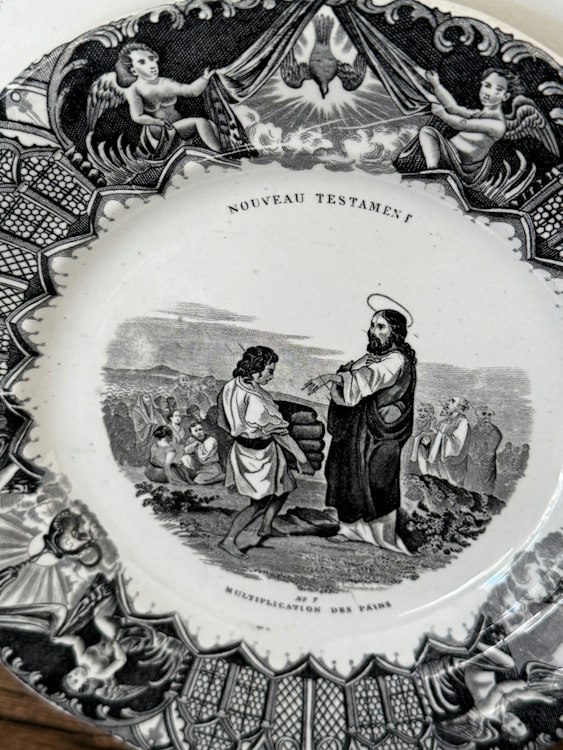
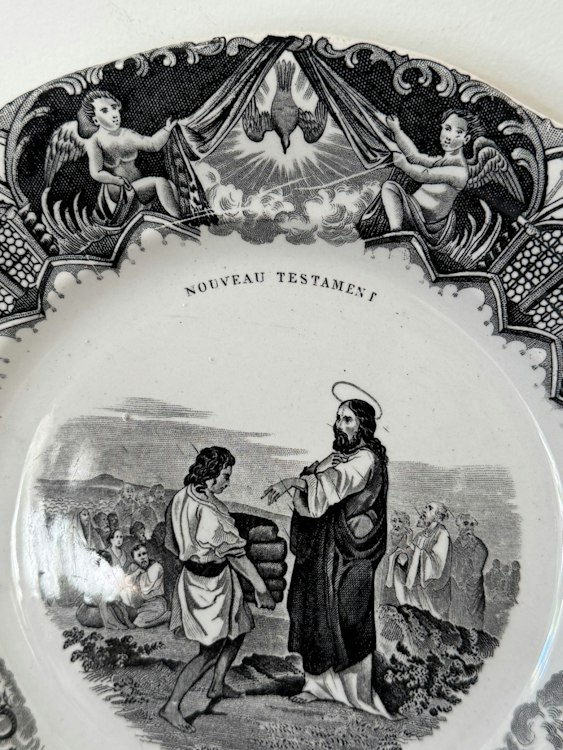
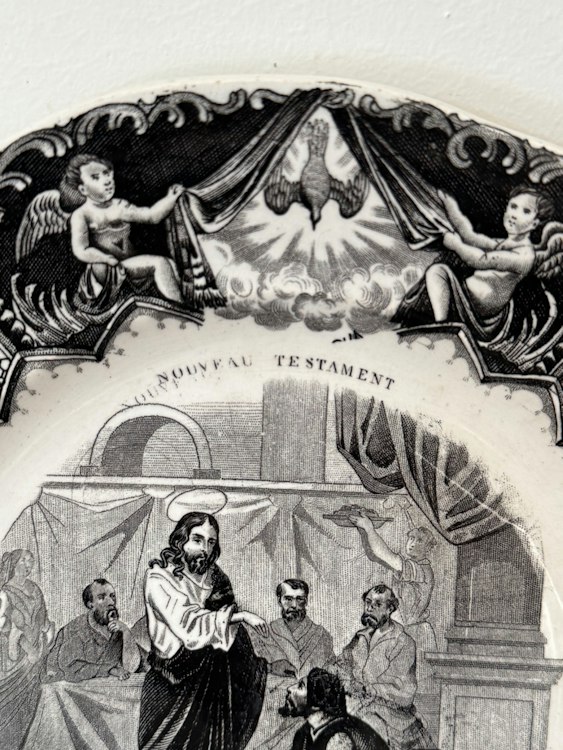
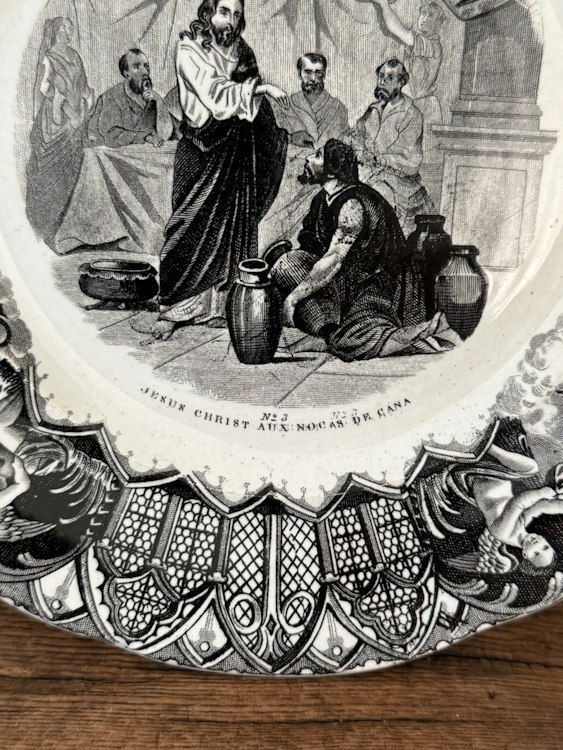
A pair of French mid-19th-century black transfer-printed creamware (*faïence fine*) decorative plates by the renowned manufacture Creil et Montereau, produced under the direction of Leboeuf, Milliet & Cie. The central medallions illustrate key narrative episodes from the New Testament: Plate N° 2 depicts *JESUS CHRIST AUX NOCES DE CANA* (The Wedding at Cana), showing Christ blessing the water jars amidst banquet guests, while Plate N° 7 depicts *MULTIPLICATION DES PAINS* (Feeding of the Multitude), showing Christ accepting loaves from a youth before a crowd.
Each central scene is framed by an elaborate Neo-Gothic revival border featuring cathedral window tracery pattern work, flanked by putti and surmounted by a central cartouche of two angels pulling back drapery to reveal the Holy Spirit in the form of a dove radiating heavenly light.
Condition Report & Provenance
- Subject / Source: New Testament scenes (N° 2 "JESUS CHRIST AUX NOCES DE CANA" and N° 7 "MULTIPLICATION DES PAINS")
- Artist / Maker: Creil et Montereau (Leboeuf, Milliet & Cie)
- Period: Mid-19th Century (c. 1855–1870)
- Origin: France
- Material / Technique: Black transfer print (*grisaille*) on cream earthenware (*faïence fine* / *porcelaine opaque*)
- Markings: Backstamped on reverse with oval mark inscribed "CREIL ET MONTEREAU / MÉDAILLES D'OR / L.M & C° / 1834. 39. 44. 49 & 55 / PORCEL. OPAQUE"
- Decorative Details: Neo-Gothic architectural tracery rim with angelic cartouche and Holy Dove motif
- Condition: Minor wear to rim edges and gentle surface crazing typical for French earthenware of this period; no visible cracks or major restoration
History
During the 19th century, French manufactories such as Creil et Montereau, Choisy-le-Roi, and Gien produced themed series of decorative transferware plates (*assiettes parlantes*) depicting historical events, literature, fables, and biblical history. The partnership of Leboeuf, Milliet & Cie (active 1840–1876) gained international acclaim for their refined transfer-printing techniques and technical innovations, earning gold medals at the French Industrial Expositions and Paris World Fairs cited on the backstamp of these plates.