
Antique Victorian Staffordshire Pottery Scottish Highland Couple Flatback Figurine
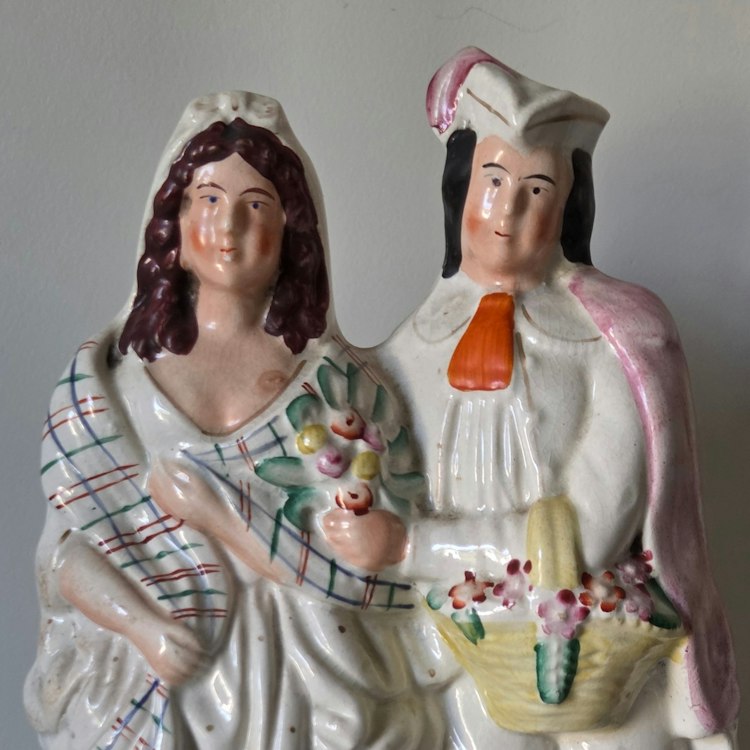
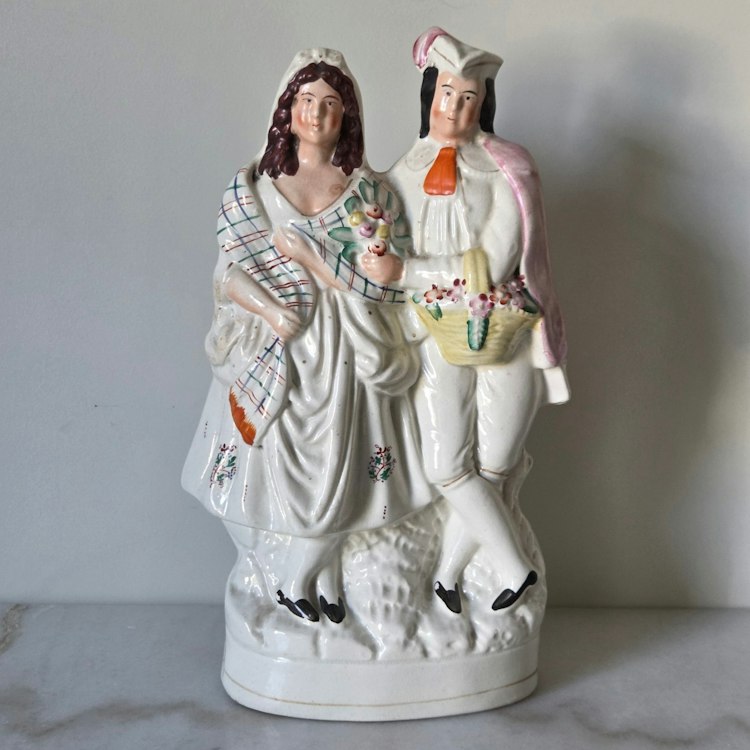
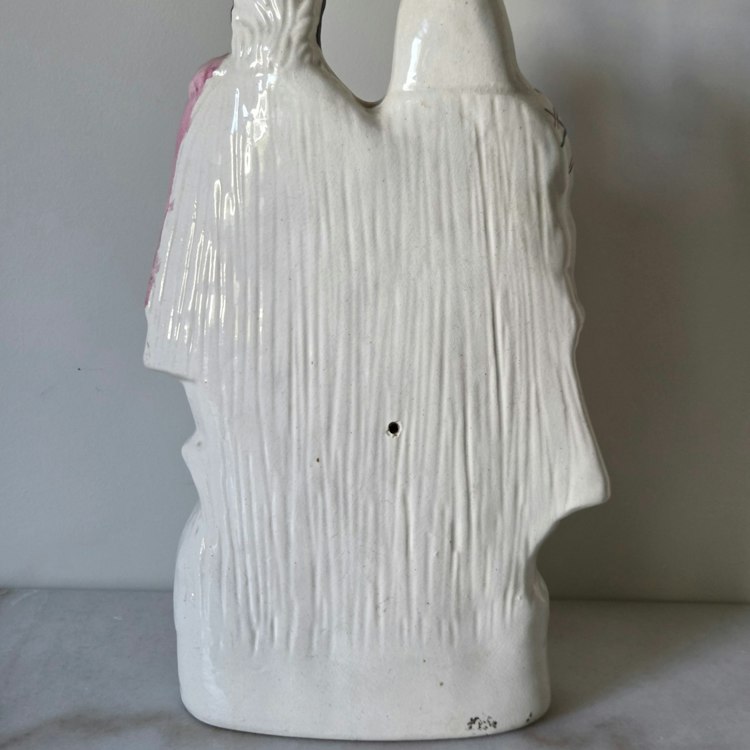
About product: A beautiful, authentic mid-19th century Victorian Staffordshire pottery flatback figurine depicting a charming Scottish Highland couple. The press-molded earthenware group features a highlander gentleman and his companion standing arm-in-arm atop a stylized grassy oval mound base. The lady wears a molded veil, a bodice with delicate floral sprigs, and a hand-painted tartan plaid wrap draped over her shoulder. The gentleman is attired in a traditional Scottish kilt outfit, a feathered hat, a bright orange cravat, and a draped pink cape, holding an over-the-arm woven flower basket overflowing with pink blossoms. This classic press-molded mantle piece displays the naive modeling and vivid hand-painted overglaze enamels that give early English potteries their enduring folk art charm. Historical & Style Details - Subject / Sitter / Source: Romanticized Scottish Highland Couple - Artist / Maker / Author: Unknown Staffordshire Potteries Artisan - Period: Mid-Victorian / High Highland Revival Era (circa 1850 - 1860s) - Origin: Staffordshire, England - Material / Technique: Press-Molded Earthenware / Hand-Painted Overglaze Enamels - Materials: Lead-glazed earthenware, overglaze enamel pigments - Markings: Unmarked; features a distinct single slip-casting kiln release hole on the reverse - Decorative Details: Hand-painted red and green tartan plaid shawl, basket of modeled pink flowers, molded vertical texture lines on the flatback reverse - Dimensions: 13.0 inches tall x 6.5 inches wide (33.0 cm x 16.5 cm) - Colour & Surface: Creamy white lead-glazed ground accented with vibrant pink, forest green, orange, cobalt blue, and black enamels; showcases stable, authentic glaze crazing - Condition: Very good antique condition; light, age-appropriate enamel wear to the hair and shoes, uniform crazing, no major chips, cracks, or professional restorations - Seller's Note: A wonderfully intact Victorian mantle piece that exemplifies the mid-19th century British obsession with Scottish folklore and romanticized rural life. History: This historic flatback figurine was born out of the immense cultural phenomenon known as "Highlandism" or the Scottish Revival, which swept through Victorian Great Britain during the mid-19th century. This movement was deeply fueled by Queen Victoria and Prince Albert’s profound love for Scotland, which culminated in their purchase and expansion of Balmoral Castle in 1852. In response to the public's fascination with romanticized Scottish history, literature by Sir Walter Scott, and traditional Highland dress, the potteries of Staffordshire produced thousands of affordable earthen figures for working and middle-class homes. Designed primarily as "flatbacks," these pieces were meant to sit flush against a fireplace mantel or parlor shelf, remaining unpainted on the back to save on expensive enamel pigments. The presence of the single clean vent hole on the back was essential to allow gasses to escape during the firing process, preventing the hollow earthenware from exploding in the coal-fired bottle kilns.
$215.00· Free shipping
A beautiful, authentic mid-19th century Victorian Staffordshire pottery flatback figurine depicting a charming Scottish Highland couple. The press-molded earthenware group features a highlander gentleman and his companion standing arm-in-arm atop a stylized grassy oval mound base. The lady wears a molded veil, a bodice with delicate floral sprigs, and a hand-painted tartan plaid wrap draped over her shoulder. The gentleman is attired in a traditional Scottish kilt outfit, a feathered hat, a bright orange cravat, and a draped pink cape, holding an over-the-arm woven flower basket overflowing with pink blossoms. This classic press-molded mantle piece displays the naive modeling and vivid hand-painted overglaze enamels that give early English potteries their enduring folk art charm.
Historical & Style Details
- Subject / Sitter / Source: Romanticized Scottish Highland Couple
- Artist / Maker / Author: Unknown Staffordshire Potteries Artisan
- Period: Mid-Victorian / High Highland Revival Era (circa 1850 - 1860s)
- Origin: Staffordshire, England
- Material / Technique: Press-Molded Earthenware / Hand-Painted Overglaze Enamels
- Materials: Lead-glazed earthenware, overglaze enamel pigments
- Markings: Unmarked; features a distinct single slip-casting kiln release hole on the reverse
- Decorative Details: Hand-painted red and green tartan plaid shawl, basket of modeled pink flowers, molded vertical texture lines on the flatback reverse
- Dimensions: 13.0 inches tall x 6.5 inches wide (33.0 cm x 16.5 cm)
- Colour & Surface: Creamy white lead-glazed ground accented with vibrant pink, forest green, orange, cobalt blue, and black enamels; showcases stable, authentic glaze crazing
- Condition: Very good antique condition; light, age-appropriate enamel wear to the hair and shoes, uniform crazing, no major chips, cracks, or professional restorations
- Seller's Note: A wonderfully intact Victorian mantle piece that exemplifies the mid-19th century British obsession with Scottish folklore and romanticized rural life.
History
This historic flatback figurine was born out of the immense cultural phenomenon known as "Highlandism" or the Scottish Revival, which swept through Victorian Great Britain during the mid-19th century. This movement was deeply fueled by Queen Victoria and Prince Albert’s profound love for Scotland, which culminated in their purchase and expansion of Balmoral Castle in 1852. In response to the public's fascination with romanticized Scottish history, literature by Sir Walter Scott, and traditional Highland dress, the potteries of Staffordshire produced thousands of affordable earthen figures for working and middle-class homes. Designed primarily as "flatbacks," these pieces were meant to sit flush against a fireplace mantel or parlor shelf, remaining unpainted on the back to save on expensive enamel pigments. The presence of the single clean vent hole on the back was essential to allow gasses to escape during the firing process, preventing the hollow earthenware from exploding in the coal-fired bottle kilns.